
Monthly Archives: January 2026
The maximum weight data placard on forklifts should never be regarded as the maximum amount able to be lifted. There are several factors that affect the lifting capacity, which is often reduced for various reasons. It is important to remember the lifting capacity is based upon the load center.
Did you know you lose the weight-lifting capacity for every one inch beyond the actual load center? It is your responsibility to calculate the load center for any type of attachment used with the truck, including the original one. In addition, each time you switch attachments, it is essential to recalculate the load center and maximum load lift capacity of the forklift.
To learn more about the factors that affect the load center and load capacities, please feel free to continue reading the following infographic presented by Lift Truck Capacity Calculator. We can also provide assistance with determining the load center for a variety of attachments, as well as those that are worn by contacting us directly.

Driving a forklift or similar heavy lifting equipment is a responsibility not to be taken lightly—if handled improperly, these heavy mobile vehicles can cause serious damage both to the immediate environment and to human beings in their path.
To a large extent, safe operating procedures are a matter of simple common sense, but sometimes accidents happen even to experienced, mindful drivers. In a significant number of these incidents, the problem can be traced to a very simple cause: inaccurate capacity data labels.
Data labels are easy enough to ignore. Some forklift drivers rarely, if ever, glance at them, preferring instead to trust gut feelings developed through long experience. This is a mistake, however. It’s important to refer to these labels to ensure the maximal operating safety of lifting equipment—but this information is useless if it is out of date or just plain wrong.
Inaccurate data labels can cause multiple problems for you; let’s explore the issue further in the infographic posted below.
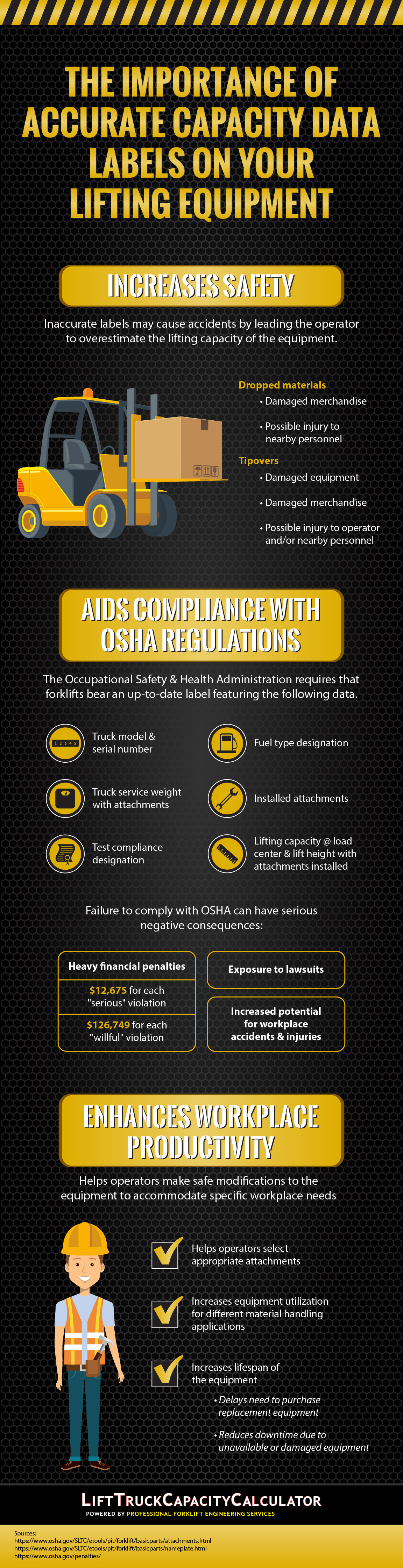
If your company uses a forklift, you know how important this piece of equipment is to your business and how versatile it can be with the use of special forklift attachments. These special attachments are used to transform from simple lifting forks, into a multi-purpose machine designated for a very particular task.
The different types of special forklift attachments are virtually unlimited but typical attachments include side shifters, fork positioners, rotators, paper roll clamps, box clamps, bale clamps, appliance clamps, concrete block clamps, push-pulls (also called slip-sheet attachments), load extenders and stabilizers, hay clamps, bale spears, carriages, skips or waste bins, scoops, buckets, booms, crane jibs, fork mounted hooks, forks, fork extensions, bulk bag handlers, snow ploughs, yard scrapers, fork mounted drum handlers and drum rotators, work platforms and cages just to name a few. Special custom made and in-house fabricated attachments are also often used.
If you need to use special forklift attachments, you will also need to certify and label the forklift with an updated data plate to reflect the new forklift configuration and the new lifting capacity. Updating the data plate when you change front end attachments is an OSHA regulation that falls under OSHA regulation CFR 29 1910.178 referencing “powered industrial truck addition/modification approval and marking requirements”. Professional Forklift Engineering Services has qualified professional engineers that can help you get your forklifts OSHA compliant in this regard.
